Forex Trading for Beginners
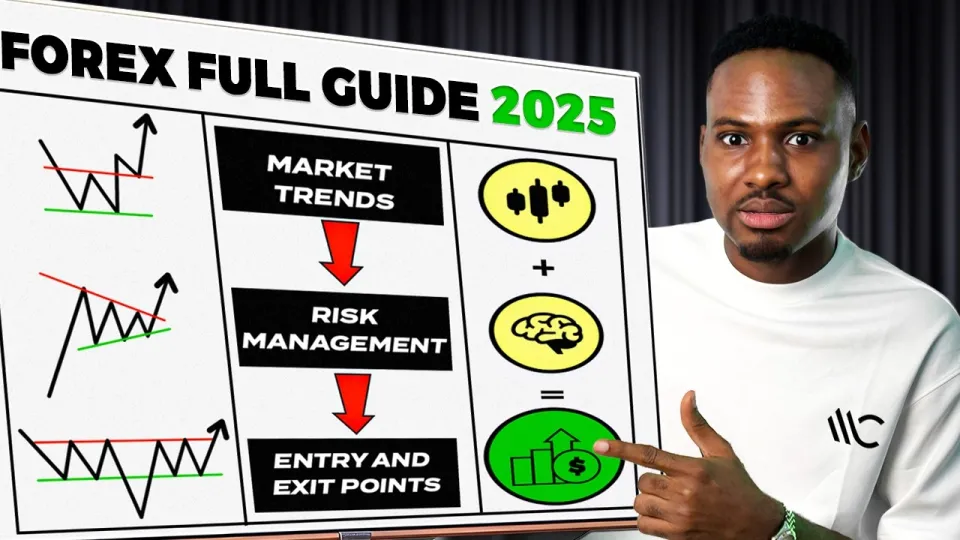
Video: How To Start Forex Trading For Beginners’ 2025 (Full Course)
You can order the same kind of articles for your own video to boost it on YouTube and Google. Just message the Telegram bot @sat_sit_bot. Articles with your video embedded are written and posted by the bot itself — on popular topical sites (no ads). Try it free: 50 articles on us.
Forex trading for beginners means buying and selling currency pairs on an over-the-counter market that runs 24 hours a day, five days a week. To start, you need a regulated broker, a platform such as MetaTrader 5, a demo account and a written risk plan. A structured course — like the full beginner programme from Jeffrey Benson Forex — compresses the basics into a single roadmap instead of scattered tips.
What forex is and how currency pairs are quoted
Forex is the exchange of one currency for another, and every price you see is a ratio between two currencies. A quote such as EUR/USD = 1.0850 means one euro buys 1.0850 US dollars; the first currency is the base, the second is the quote currency. When the number rises, the base currency is strengthening against the quote currency, and when it falls, the opposite is true.
Three conventions matter for a new trader:
- Majors — the most liquid pairs, all involving the US dollar: EUR/USD, GBP/USD, USD/JPY, USD/CHF, AUD/USD, USD/CAD and NZD/USD. Spreads are tightest here.
- Crosses — pairs without the dollar, such as EUR/GBP or GBP/JPY. They usually carry wider spreads and sharper moves.
- Exotics — pairs like USD/TRY or USD/ZAR, where wide spreads and political risk make them a poor starting point for beginners.
Prices are quoted in pips, the standard unit of movement. For most pairs a pip is the fourth decimal place (0.0001), while for yen pairs it is the second decimal (0.01). A move from 1.0850 to 1.0860 on EUR/USD is ten pips.
How the forex market actually works
Forex has no central exchange: banks, brokers and funds trade directly with each other through a network of liquidity providers, which is why it is called an over-the-counter market. Retail traders reach that liquidity through a broker, and the broker's price feed is what appears on your chart.
The trading week opens in Sydney on Monday morning and closes in New York on Friday evening. Volume concentrates in four sessions:
- Sydney — the quietest session, useful mainly for AUD and NZD pairs.
- Tokyo — active in the Asian morning, with JPY pairs most responsive.
- London — the largest share of daily turnover and the widest ranges in EUR and GBP pairs.
- New York — driven by US data releases, with the London–New York overlap typically the most liquid window of the day.
Two structural details shape results more than most beginners expect. First, leverage is expressed as a ratio — 1:100 means a $1,000 deposit controls $100,000 of currency — and it magnifies losses exactly as it magnifies gains. Second, the spread is the broker's built-in cost on every trade, so a strategy that targets five pips per trade while paying a two-pip spread starts with a heavy handicap.
Tools every beginner needs before the first trade
A beginner's toolkit is small: a broker account, a trading platform, a charting setup and a risk calculator. Everything else is optional until the basics are consistent.
- A regulated broker. Check which regulator supervises the entity you are signing with, what deposit minimum applies, and how spreads and commissions are structured. Regulation determines how client funds are protected, not how profitable the broker is.
- MetaTrader 5 (MT5). The platform used in the Jeffrey Benson Forex walkthrough: it handles charts, order types, indicators and a demo account. MT4 remains common, but MT5 is the current default for most new accounts.
- A demo account. Trade the same strategy on simulated money for at least one to three months before risking real capital. The goal is a documented track record, not a feeling of confidence.
- A trading journal. Record entry, exit, position size, reason for the trade and screenshot for every position. Reviewing it weekly exposes patterns that memory hides.
- An economic calendar. Interest-rate decisions, inflation prints and employment data move currencies in seconds; knowing release times prevents accidental exposure.
Building a basic forex strategy foundation
A strategy is a written set of conditions that tells you when to enter, where to exit and how much to risk — nothing more complicated is required to begin. Most beginner frameworks rest on three pillars: market structure, a trigger and a stop.
- Market structure answers the direction question. Higher highs and higher lows suggest an uptrend; lower highs and lower lows suggest a downtrend. Trading with the prevailing structure is simpler than predicting reversals.
- Support and resistance mark price zones where buyers or sellers previously stepped in. A pullback into a zone in the direction of the trend is the classic beginner setup.
- The trigger is the confirmation that the pullback has ended — a candlestick pattern, a break of a short-term high, or a moving-average reclaim. Without a trigger, entries become guesses.
- The stop-loss defines where the idea is wrong and must sit beyond the structure that justified the trade, not at a round number chosen for comfort.
Position sizing follows from the stop. If you risk 1% of a $2,000 account — $20 — and your stop is 20 pips away on EUR/USD, the correct position is roughly 0.10 lots, because one standard lot moves $10 per pip. Fixing risk first and letting the stop distance determine size keeps every loss the same weight.
Placing a first trade step by step
Placing a trade is a mechanical sequence, and doing it in the same order every time removes most beginner errors. Work through it on a demo account first.
- Open the pair on MT5 and confirm the current session and spread.
- Mark the trend on a higher timeframe, then the nearest support or resistance zone.
- Wait for price to reach the zone and for your trigger to appear.
- Calculate position size from the stop distance and your fixed risk percentage.
- Place a market order with a stop-loss and a take-profit attached in the same ticket.
- Log the trade in the journal with a screenshot.
A common beginner alternative is a pending order — a buy limit below the current price or a sell limit above it — which enters automatically if price reaches the zone without you watching the screen. Both approaches are valid; the non-negotiable part is that the stop-loss is set at entry, not added later after the trade turns red.
Common mistakes that cost beginners money
Most early losses come from process errors rather than bad analysis, and they repeat across almost every new account. The most expensive ones are predictable.
- Risking too much per trade. A run of five losses at 10% risk each cuts an account by more than 40%; at 1% risk the same run costs about 5%.
- Trading without a stop-loss. A single unhedged position during a news spike can wipe out months of gains.
- Overtrading. More positions do not mean more profit; they multiply spread costs and dilute attention.
- Revenge trading. Re-entering immediately after a loss to "win it back" is the fastest route from a small drawdown to a large one.
- Skipping the demo phase. Real money exposes emotions that simulated money cannot, so build the routine first and fund the account second.
- Following signals blindly. Copying trades without understanding the setup means you cannot manage the position when the signal provider is offline.
Questions beginners ask most often
New traders tend to ask the same few things before committing capital, and the answers are practical rather than theoretical. How much money is needed depends entirely on position sizing: with 1% risk per trade, a $500 account allows $5 of risk, which is workable on micro lots but leaves little room for error. How long the learning phase lasts varies — a few months of consistent demo results is a reasonable benchmark, not a fixed deadline.
Another frequent concern is whether forex trading can replace a salary quickly. It cannot: returns compound over hundreds of trades, and accounts that grow fast usually do so by taking risks that eventually erase the gains. The most repeated piece of advice in the comments under the Jeffrey Benson Forex course is to write everything down while learning — the four sessions, the entry rules, the risk per trade — because a written manual is what you actually use on a live account.
Useful links
- Jeffrey Benson Forex student plans — course and mentorship tiers.
- Free daily signal channel — one free trade idea per day.
- Broker registration used in the course — account opening link.
- Premium signal group access — subscription via Telegram bot.
Bottom line
Forex trading rewards a boring, repeatable process: understand the pair, trade with structure, risk a fixed small percentage, and journal every position. The full beginner course from the Jeffrey Benson Forex channel is a useful single reference for that process, covering market mechanics, tools, strategy foundations, a first trade and the mistakes that drain new accounts. Start on a demo account, prove the routine over dozens of trades, and only then add real money. Anyone promising fast riches is selling something other than trading skill.
Key takeaways
- Forex is an over-the-counter market where currencies are traded in pairs, such as EUR/USD, 24 hours a day, five days a week.
- Beginners need four things: a regulated broker, a trading platform such as MetaTrader 5, a demo account and a written trading plan.
- Risk management comes first: many educators cap risk per trade at 1–2% of account equity and use stop-loss orders on every position.
- The market runs in four sessions — Sydney, Tokyo, London and New York — and the London–New York overlap is the most liquid window.
- Jeffrey Benson Forex's full beginner course covers market basics, tools, strategy foundations, a first trade and common mistakes.
Source: How To Start Forex Trading For Beginners’ 2025 (Full Course) · Markdown version
Questions & answers
How much money do I need to start forex trading?
There is no fixed minimum, because the right deposit depends on your risk per trade. If you risk 1% per trade, a $500 account allows $5 of risk, which fits micro lots on most pairs. Many brokers accept smaller deposits, but very small accounts leave little room for a losing streak.
Is forex trading suitable for complete beginners?
Yes, provided you treat the first months as training rather than income. Learn how pairs are quoted, how sessions affect liquidity, and how position sizing works, then practise on a demo account until your results are consistent. Skipping that phase is the most common reason beginners lose money.
How long does it take to become profitable in forex?
Most traders need several months of deliberate practice before results stabilise, and there is no guaranteed timeline. A practical benchmark is a few months of consistent demo results with a written plan and a journal. Profitability comes from repeatable risk control, not from a single good strategy.
Do I need MetaTrader 5 to trade forex?
No single platform is mandatory, but MT5 is the most common choice for new accounts and is the platform used in the Jeffrey Benson Forex course. It includes charts, pending orders, stop-loss and take-profit tools, and a demo mode. Other platforms work if your broker supports them.